

I’ve been fooling around with playing the guitar for 20 years or so. It’s not an easy instrument for me to play. Unfortunately, it just doesn’t come as natural for me as I’d like. I have to work really hard at it. Still, like many guitarists, I got caught up in wanting to play blazing fast, like Yngve Malmsteen.
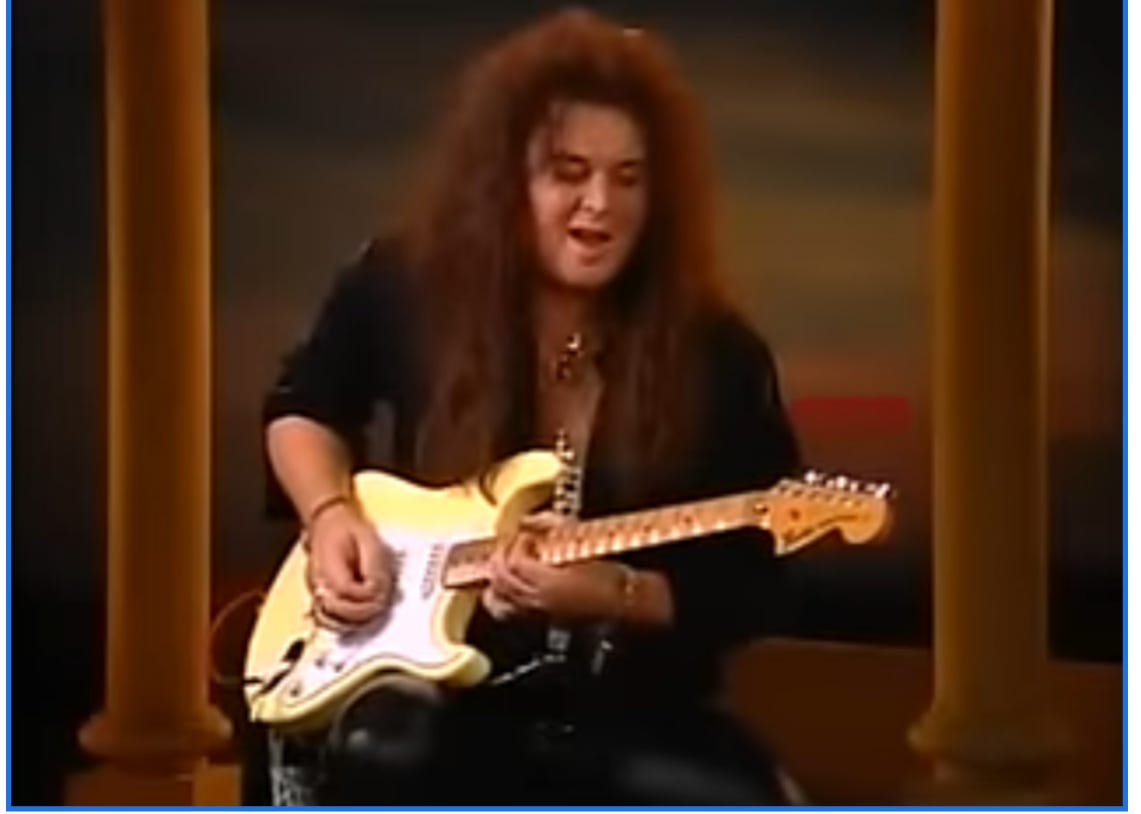
Eventually, with the help of a guitar teacher in Florida, Dyce Kimura, I began to see that I didn’t always have to go for that fast solo to have success. As a matter of fact, it was causing me years of frustration and holding me back from getting better. Sure, once in a while, I would hit a nice fast solo, but I often didn’t even know why.
In reality, some of the greatest guitar solos don’t start loud or fast. They start small, with simple melodies or phrases.
Though the role of the guitar solo in music is not as center stage these days, you can go back and listen to some of the best rock guitar players of the ‘70s, ‘80s, and ‘90s and notice how they would build into a solo at the right time.
Of course, if they wanted to go fast all the time, they absolutely could. But speed isn’t always the point.
David Gilmour of Pink Floyd was a master at slow melodic phrasing that said more with fewer notes than most players say with a flurry of them. Just listen to his second solo in Comfortably Numb, and you’ll get it (4:40 timestamp). It’s often cited as the benchmark for melodic, slow-burn guitar.
Even Eddie Van Halen, who could go blazing fast whenever he wanted, didn’t have to in order to wow you. One of my favorite songs of his is “316.” He wrote it for his son, Wolfgang, after he was born. It’s actually one I’m able to hack away at. 🤣
Eddie actually praised Gilmour:
“David Gilmour is the benchmark of less being more. He has proved that shredding and fast playing is not the benchmark of mastery level. Gilmore never wastes a note; he builds his solos like a painter; every note, every bend, every tonal inflection has merit… David’s solos paint a picture in the minds of his listeners. Something that really is a testament of his talent as a guitar player”
Neal Shon of Journey also comes to mind as one of those melodic blazers. Think Separate Ways.
I thought about this topic over the weekend when I was practicing my soloing to a chill melodic backing track, taking a break from some stock research. I didn’t try to go fast, and it felt awesome. By my fourth round playing against the track, I put in a few fast licks here and there, and it worked perfectly.
It’s like I just learned a little bit more about the track and where it allowed me to go without hurrying, so that when I strike hard with that quick riff, it sounded perfect vs. a bunch of jumbled notes
Well of course, as you would expect, I immediately tied that experience into investing. I didn’t fully realize it at first, but the way I approached playing that backing track over the weekend is exactly how I approach investing sometimes.
So many of my best stocks didn’t start as big, high-conviction, go-all-in positions. They started as small seeds or exploratory bets, without even thinking about a MultiBagger possibility or if they had to be perfect on day one.
When you think about it… psychologically, those positions are easier to make. Why? Because these will likely be smaller position size bets, where you don’t lose sleep at night. Furthermore, they allow you to listen to the story as it develops instead of forcing a conclusion upfront.
Planting seeds lets you sprinkle the portfolio and participate early without having all the answers.
And just like songwriting, not every seed turns into a hit. The point isn’t to be right immediately or all the time. The point is to give some interesting ideas room to grow.
But here’s the part that matters most… and you may have heard me talk about this on “X” or other posts I’ve written…. sprinkling only works if your process is good.
If your investing process is broken, it doesn’t matter whether you’re a high-conviction investor, a seed planter, or a mix of both. Bad process scales failure. The same is true in music. No amount of speed saves a player who doesn’t understand phrasing, timing, or feel.
And by the way, I’m obviously not saying to never take big positions right out of the gates when you see the right pitch. But don’t ignore the ones that don’t look obvious.
Just like a great guitarist doesn’t need to shred for the sake of shredding, investors shouldn’t size up for ego. Do it because the setup is right, and when the conviction is earned.
So, what am I really saying?
Sometimes it’s ok to plant early and let the melody develop. And when it’s time to play loud, let it fucking rip and play it without hesitation.
Thanks for reading Microcap Investing Cliff Notes! This post is public, so feel free to share it. We can’t wait to share our best ideas with you in 2026.
Well I am glad I took a starter position in Velo under $5, and now it's a full size position 😄
I really like this analogy